


Disclaimer
Real estate market conditions, transaction practices, and applicable laws may change. This article does not constitute legal, tax, or financial advice. Readers should consult qualified professionals before making any investment or real estate decisions. Max Berger is a licensed California real estate broker at Compass.
For owners of RSO-covered apartment buildings in Los Angeles, the strongest selling window is now through June 2026; before July 1, when a new rent increase cap takes effect that directly compresses your building's income story and lowers what buyers will pay. For non-RSO buildings, timing depends on your cap rate, rent roll, and personal financial situation more than the calendar. Q1 2026 data from Kidder Mathews shows vacancy at 5.6%, rents flat at $2,292 per unit, and per-unit pricing down 8% year-over-year to $282,900. The market is not falling; but it is tightening. Owners who wait past the July 1 deadline are selling into a different underwriting environment.
If you’ve spent any time trying to acquire apartment buildings in Los Angeles, you already know: the best deals don’t just show up on CoStar, LoopNet, or the MLS. They move through a much smaller, quieter channel like a broker call on a Tuesday morning, a conversation at the right networking event, a direct letter that lands on a long-time owner’s desk at exactly the right moment.
Off-market multifamily in Los Angeles is not a myth. It is a real and active segment of the market, and in 2026 it is arguably more important than ever. With public listings attracting multiple offers, pricing expectations still adjusting across submarkets, and a significant wave of aging ownership looking for exits, long-time family holders, estate situations, and operators exhausted by the regulatory environment, motivated sellers are increasingly choosing to transact quietly, without the friction of a full public campaign.
Off-market inventory is already driving a significant share of 2026 transactions, with buyers who have broker relationships in target submarkets seeing deals before they ever hit a public platform.
This guide breaks down how to actually find off-market apartment buildings in Los Angeles, not in theory, but in practice, with the specific channels, strategies, and credibility signals that determine whether you get the call or don’t.
What Are Off-Market Apartment Buildings, and Why Do LA Owners Choose Them?
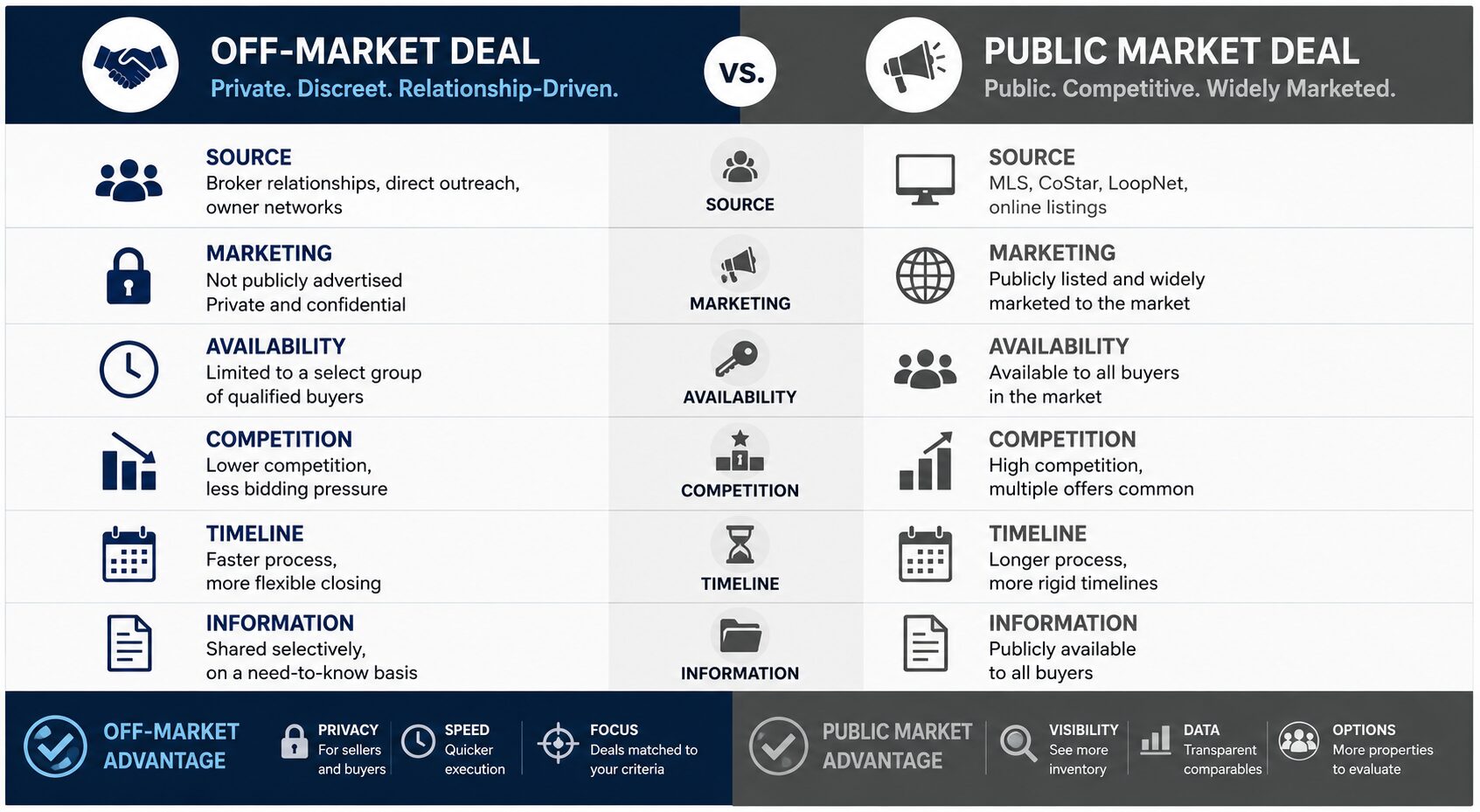

An off-market property is one that is for sale but not publicly advertised on the MLS, CoStar, LoopNet, or any other public platform. The transaction happens through private channels: a broker’s buyer list, a direct referral, an owner-to-investor conversation, or a quiet marketing effort targeted to a small pool of known buyers.
In the multifamily space, off-market deals are not rare outliers. They are a normal and regular part of how apartment buildings change hands in Los Angeles, particularly in the $2M–$15M range where most of the city’s mid-size building stock trades.
Related Source: Measure ULA Transfer Tax
Why Do LA Apartment Owners Sell Off-Market?

Understanding the seller’s motivation helps buyers position themselves correctly:
Privacy and discretion. Long-time owners, particularly multi-generational family holders, often do not want tenants, neighbors, or the broader public to know they are considering a sale. A quiet process with a known buyer eliminates that exposure entirely.
Avoiding disruption. A full public listing campaign typically involves photography, broker tours, tenant-occupied showing logistics, and several weeks of market exposure. For owners with occupied buildings, this creates friction with tenants and potential lease renewal complications. An off-market transaction skips all of it.
Speed and certainty. When a seller has a specific timeline like an estate deadline, a 1031 exchange window, a loan maturity, or a health situation, speed matters more than maximum price. Off-market deals with a known, credible buyer can close in 30–45 days without the 60–90 day public campaign cycle.
Regulatory and tax complexity. For properties near the Measure ULA transfer tax threshold, a quiet sale allows for more precise pricing strategy without the public pressure of a listed price that could get bid above the threshold.
Seller fatigue. As reported by The Real Deal in May 2026, the “death by a thousand cuts” of LA’s regulatory environment, rising insurance, RSO constraints, relocation fee requirements, is pushing a significant number of smaller and mid-size landlords to exit quietly, without fanfare, and often without ever formally listing their properties.
Property Listing: View Active Listing
How Brokers Find Off-Market Multifamily Listings in Los Angeles
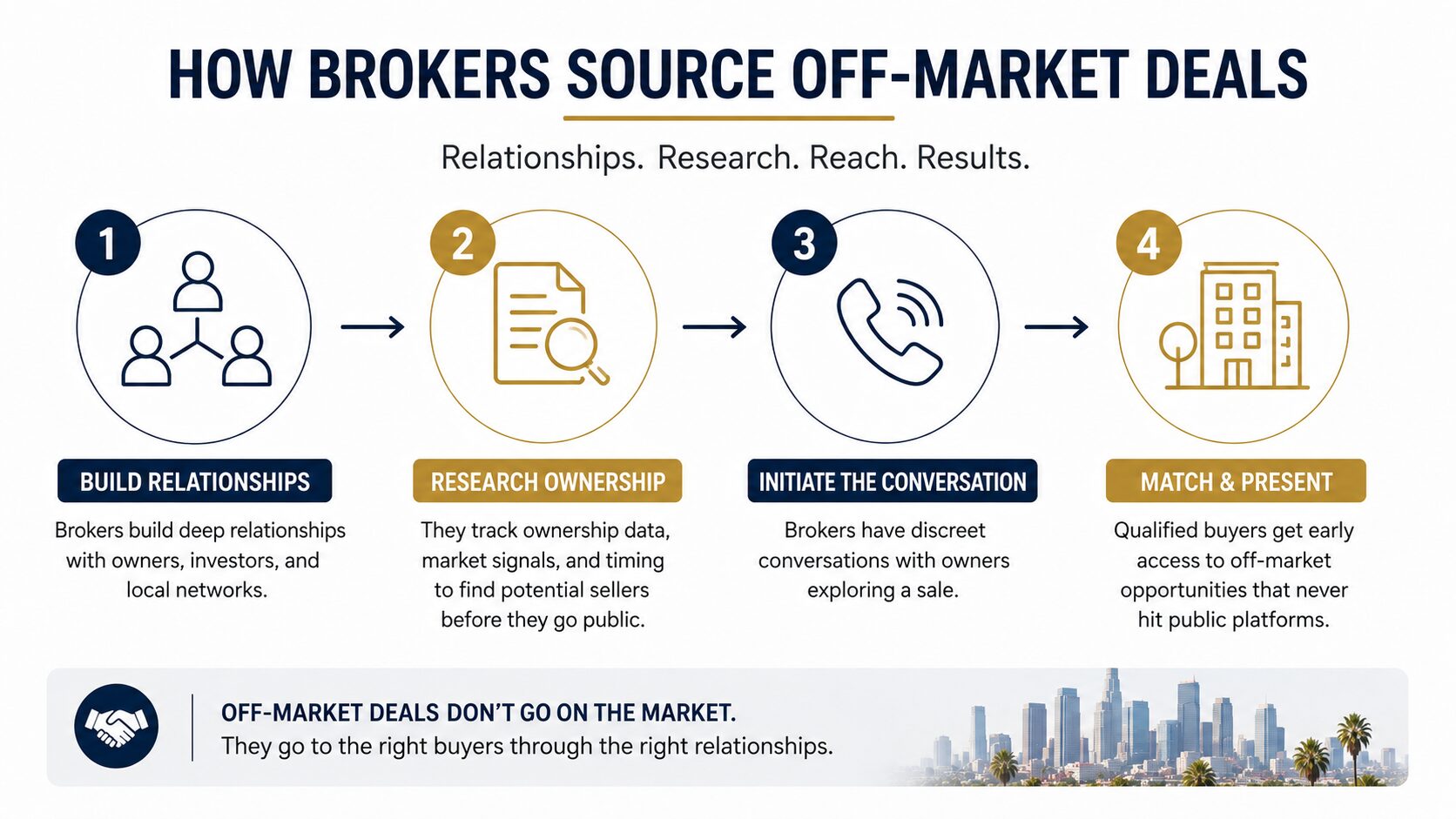
This is the most direct answer to the most common question: if you want consistent access to off-market apartment buildings in LA, the single most important thing you can do is build relationships with specialists who transact regularly in your target submarkets.
Here is how that actually works:
Submarket Specialists With Owner Relationships
A broker who has closed 15 transactions in Northeast Los Angeles over the past three years knows the owners. Not abstractly but personally. They have sat across the table from the family that owns the 12-unit on Fountain, had the conversation with the owner of the 20-unit in Silver Lake who isn’t quite ready yet but is thinking about it, and closed deals that created goodwill and referrals with the people who own adjacent buildings.
That is the relationship network off-market deals flow through.
When those owners eventually decide to sell or when a broker initiates the conversation based on ownership data and market timing, they do not always go to a broad public campaign. They often call the broker first, who in turn calls the buyers they know will underwrite quickly and execute cleanly.
Pocket Listings
A pocket listing in the multifamily context is a property where the broker holds a signed listing agreement but intentionally does not market the property publicly. It is offered directly to a curated list of buyers, typically the broker’s most active investors in that size and submarket range.
The seller may prefer this approach for the privacy and speed reasons described above. For buyers, getting onto a broker’s call list for pocket listings in specific submarkets is one of the most valuable things you can do and it requires being a known, credible buyer in that broker’s network, not a cold inquiry.
Pre-Market and Coming-Soon Deals
Separate from full pocket listings, many brokers share deals with select buyers before a public launch, sometimes 48–72 hours early, sometimes during a pre-launch period of a week or more. Buyers who respond quickly, confirm interest with real underwriting, and communicate clearly are the ones who get these windows. Buyers who take three days to respond, submit vague interest, or have a history of retrading do not get the early call the next time.
Direct-to-Owner Strategies: What Actually Works in LA
For buyers who want to build deal flow independent of broker relationships, direct outreach to property owners is the other primary channel. It is slower and more labor-intensive, but it produces results, particularly for buyers who are consistent over time.
Targeted Direct Mail
The most established direct-to-owner strategy is targeted mail campaigns. Using property data from sources like CoStar, CBRE Econometric Advisors, or county assessor records, you identify buildings that match your acquisition criteria: size, location, year built, ownership structure, estimated hold period.
You then send personalized letters, ideally handwritten or with a personal tone, to the recorded owners expressing your interest in acquiring their building.
The key word is “targeted.” Generic blast mail to every owner in a zip code is low signal. A well-researched letter to a specific owner, referencing the specific property, the neighborhood, and your genuine interest in that asset, carries more weight.
Do not expect immediate responses, effective direct mail campaigns work on 6–12 month timelines with multiple touchpoints. The goal is to be the name in the owner’s mind when they are finally ready to have the conversation.
Ownership Research and Public Records
Los Angeles County assessor records are publicly available and searchable. For any property you’re interested in, you can research the recorded owner, vesting type (individual, LLC, trust, family trust), and transfer history. Buildings held in a family trust for 20–30 years, or properties where ownership recently transferred due to death or estate settlement, are worth prioritizing. These represent situations where seller motivation may be elevated even if nothing is publicly listed.
If a property is owned by an LLC, you can research the entity through California Secretary of State records to find the managing member or registered agent. This takes more effort but can produce direct access to an owner who has never been approached by a broker.
Driving for Dollars (and Knowing What You’re Looking At)
In multifamily investing, “driving for dollars” means physically visiting submarkets you want to invest in and identifying buildings that show signs of deferred maintenance, management neglect, or ownership fatigue: overgrown landscaping, unit vacancy patterns, faded paint, aging building systems.
These are often signals that an owner may be approaching the end of their operational runway, even if they haven’t acknowledged it to themselves yet. Following up with public records research and a personal outreach letter can open conversations that a broker blast never would.
Probate and Estate Properties
One of the most underappreciated sources of off-market multifamily supply in Los Angeles is the probate pipeline. The city has a substantial inventory of apartment buildings held by aging ownership. Multi-generational families, long-time individual investors, trusts established decades ago.
When those owners pass, the property either goes through probate (if no trust exists) or into a trust administration process (if it was held in a living trust). As documented in actual Los Angeles transactions, these situations regularly involve title complexity, multiple beneficiaries with differing goals, and owners who were reluctant to sell but whose heirs need to liquidate.
Buyers who understand how to work through this complexity and who have a broker who knows how to handle it have access to deals that most of the market never sees.
For a broader look at the LA market and ownership transition dynamics, our 2026 Los Angeles Multifamily Market Report covers the regulatory and ownership-shift trends that are accelerating this pipeline.
How to Position Yourself as a Buyer Who Gets the Call

Finding off-market deals in LA is only half the equation. The other half is being the kind of buyer that brokers and sellers actually want to work with. In a market where discretion matters and sellers are choosing private transactions precisely to avoid uncertainty, buyer credibility is the filter that determines who gets access and who doesn’t.
Have Clear, Specific Criteria
Vague buyers do not get pocket listing calls. “I’m interested in anything in LA” is noise. “I’m targeting 8–20 unit RSO buildings in Northeast LA or Hollywood with below-market rents, a 1031 exchange window of 45 days, and the ability to close all-cash or with a lender I’ve closed three deals with in the past 18 months” that is a buyer a broker can work with. The more specific your criteria, the easier it is for a broker to match you to a deal the moment it surfaces.
Respond Fast
The most consistent complaint from brokers in the off-market LA multifamily space is buyer response time. When a pocket listing or pre-market deal is shared with a short-list of buyers, the window is often 48–72 hours before the seller’s preference shifts or the situation changes.
Buyers who take three days to respond, who need multiple follow-ups to confirm interest, or who engage without real underwriting are effectively removing themselves from the list. Prompt, substantive responses even to say “I’ve underwritten it, it doesn’t work at this price but here’s why” build more credibility than silence.
Demonstrate Proof of Funds and Closing History
Sellers in off-market situations are often choosing privacy over price. That means they care about execution certainty. Having documented proof of funds, a clear financing plan, and references from prior closings, particularly within the LA multifamily market separates a credible buyer from an aspirational one.
If you’ve closed deals with a specific lender in this market, say so. If you’ve completed successful 1031 exchanges, that matters to sellers who are navigating the same decisions. Our guide to selling multifamily real estate in LA in 2026 gives useful context on what sellers are prioritizing in today’s market.
Don’t Retrade
In the off-market world, your reputation is your access. Retrading that is, renegotiating price or terms after an accepted offer without a substantive underwriting reason is the fastest way to burn broker relationships and get removed from deal flow permanently. Serious buyers in the LA market know this and behave accordingly.
About Max Berger: Off-Market Access in the LA Multifamily Market
An Ownership Mindset, a Decade of Relationships
Max Berger is a Los Angeles multifamily specialist with over a decade of exclusive focus on apartment building sales across the city. With more than 75 transactions and $300 million in closings behind him, Max’s value to both buyers and sellers is not just market knowledgeit is the network of owner relationships built through years of consistent presence in the neighborhoods where deals actually happen.
If you are a buyer looking for off-market apartment buildings in Northeast Los Angeles, Hollywood, Koreatown, South LA, or the San Fernando Valley or if you are an owner thinking about a quiet, private transaction a direct conversation is the first step.
There is no pitch here and no pressure. Off-market deals work when both sides are ready. The goal is to understand your situation and let you know, honestly, what we’re seeing in the market right now and whether there’s a match.
Contact Max Berger to Talk Off-Market Opportunities →
Or if you’re an owner considering a sale and want to understand what your building is worth before making any decisions, request a free property valuation here. You can also browse active apartment building listings across Los Angeles to see what’s currently on the market.
The Right Broker Already Knows Which Buildings in Your Target Submarket Are Moving Quietly. Are You on That Call List?
Max Berger will tell you exactly what your building is worth today, how the RSO change affects your specific NOI, and whether selling before July 1 makes sense for your situation. Free, no obligation, no pressure.